
Does Your Home Need Roof Ventilation?
Without proper roof ventilation, heat and moisture can damage your home, raise energy bills, and shorten the life of your shingles. Here''s what you need to know.
At Integrity Roofing, we believe that the roof is a very important part of a home as it protects us from outside forces. As part of the roof system, the shingles and underlayment limit the impacts of weather and exterior elements on the structure. Similar to having a protective seal to prohibit something from penetrating the desired object, shingles and underlayment mimic that protective membrane — though they require ventilation. Without the necessary ventilation, many problems can arise, even reducing the lifespan of the shingles.
Why Ventilate?
The main purpose of roof ventilation is to control moisture through an attic, ensuring the space is the desired temperature throughout the seasons.
For example, without proper ventilation in the summer, poor airflow can produce excessive heat in the attic. The buildup of heat can create attic temperatures as high as 140°F on a 90°F day. Eventually, this heat moves into the living spaces, causing any form of cooling system to work harder and waste more energy to maintain proper temperature.
Another example is in the winter. Insufficient ventilation allows ice dams to form at the eaves. Ice dams cause roof runoff to back up behind the ice dam and seep underneath shingles and fascia boards. Once this moisture enters the home, several problems can occur — ranging from damage to interior and exterior walls, to peeling paint and cracked ceilings.
How Does Ventilation Work?
Correctly ventilating a home requires a measured balance of air intake and exhaust to move air throughout the structure. To establish a steady, high-volume airflow, ventilation system components must be properly sized and installed. Natural or mechanical features can provide sufficient airflow.
Air Intake Vents
Air intake vents promote cool outside air to move into attic spaces. The three most common types of air intake vents are:
- Eave vents
- Individual soffit vents
- Continuous soffit vents
Exhaust Vents
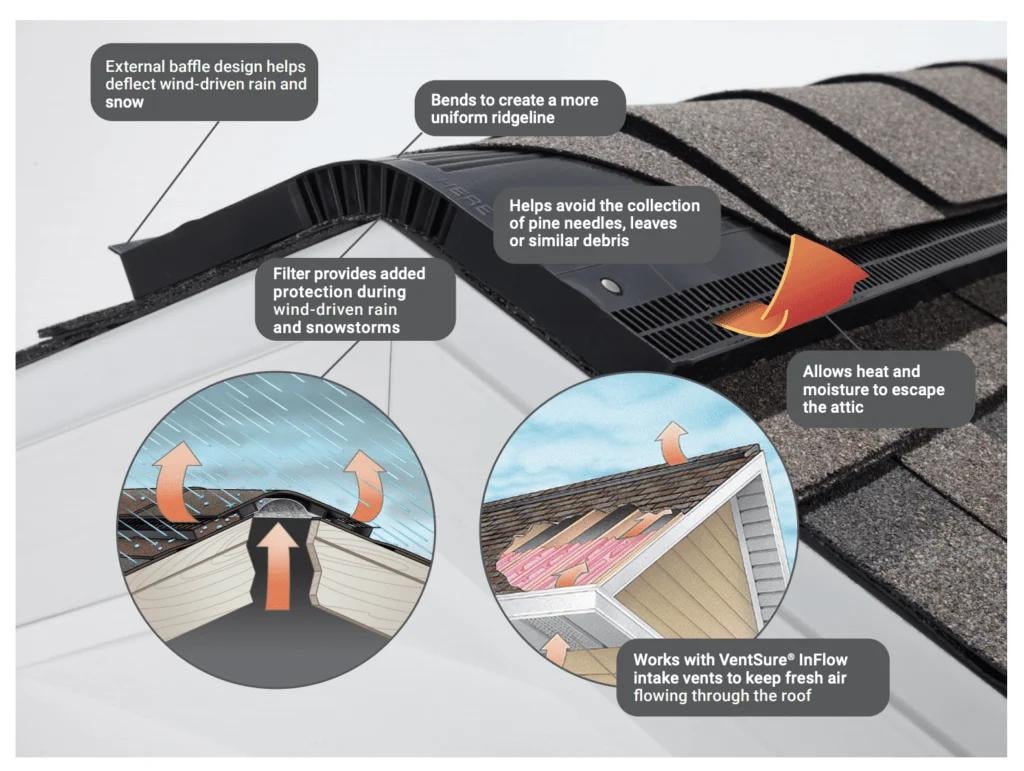
On the opposite side of the spectrum, exhaust vents cause outside air to move through the attic, assisting warm air in exiting. Exhaust vents are placed above intake vents — often near or at the roof ridge — to allow natural convection to occur.
Not sure if your roof is ventilated properly? Do you feel your house is not energy efficient? Let us take a look! Contact Integrity Roofing Group today for a professional inspection.
Explore Topics
Written by
Jesse Reeves
Content creator and writer sharing insights and stories.

